John Ludlam discusses his novel We Are Made with leading book blogger Emily Quinn, of A Quintillion Words, to talk 1930s surprises, historical accuracy versus storytelling freedom – and a spot of fantasy casting…
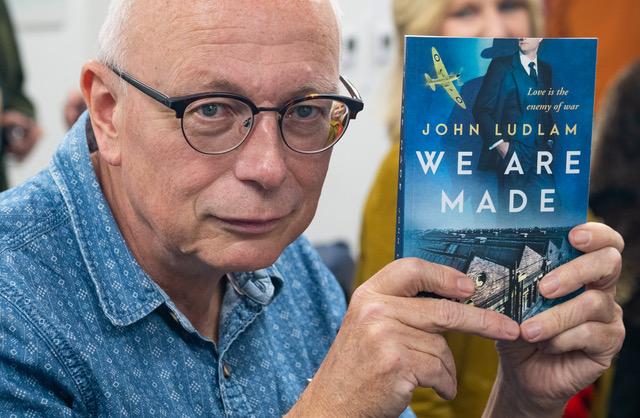
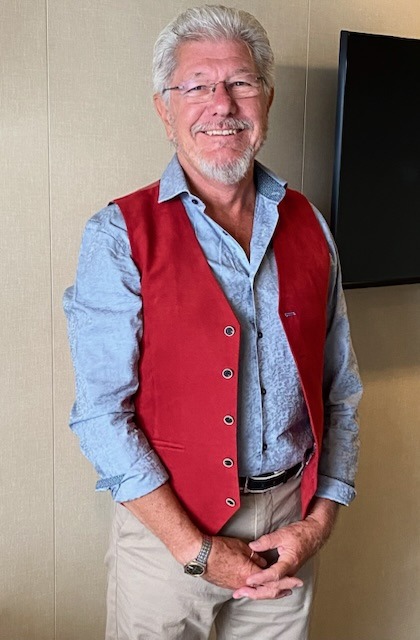
John’s book launch in Teignmouth, Oct 2024
Q.Why did you choose London in 1938 as the setting for We Are Made? Is there anything particular about the time and place that calls to you or that captured your imagination?
We Are Made isn’t just set in London, it’s set in Enfield, the suburb of north London where I grew up. Most of the adults I knew when I was a boy were profoundly affected by the Second World War and I wanted to write about what it must have been like for people in Enfield to feel caught up in the geopolitical movements sweeping across Europe in 1938.
Q.The looming threat of war is a powerful backdrop. How do you think this tension and uncertainty influences your character’s actions or decisions in We Are Made?
As a student of history, the novel’s protagonist, William, recognises that today’s tensions and uncertainties herald tomorrow’s uncomfortable realities. Unfortunately, William’s not the only one who thinks like this – the novel’s principal antagonist always seems one step ahead of him!
Q.How much research did you do to bring this era to life? Did you learn anything surprising or particularly interesting?
I have always been fascinated by the 1930s and I’d already read a lot about that decade before I started work on the novel. But, as I read deeper into the period, I was shocked at how easily Fascists and Nazi sympathisers were able to penetrate the British establishment. Extremely dangerous people were exploiting the authoritarian instincts of Britain’s rich and powerful in 1938 – we should not forget this, as we ponder present-day threats to our democracy.
Q.Tell us more about the relationship between William and Elizabeth – was it always central to the plot of We Are Made, or was it something that naturally developed as you wrote?
William and Elizabeth have been with me for a long time and their relationship was always going to be central to the novel. They first appeared in sketches I wrote for a planned novel in the early 1990s but life intervened and I never got to write that book. It was important to me that Elizabeth had agency – even if some of her decisions are forced upon her by circumstances. She was a strong character right from those early sketches. She was always going to be far more than William’s ‘love interest’.
Q.Tell us about your writing routine. Are you a planner or more spontaneous?
I wish I were a better planner but it’s just not in me! I start a book with a vague idea, an incident, perhaps, and a character or two. Then I plunge in and begin spontaneously writing scores of random scenes, while immersing myself in research matter. Slowly, a narrative forms and the research gets more focused, so as to support the emerging story. After an awful lot of this palaver, I learn where the story is going and what the final scene will be. There’s still plenty of work to do by this point but there’s a structure in place and that’s a tremendous help.
Q.How do you balance historical accuracy with the freedom of storytelling?
The story comes first. But I do think that the stuff you make up should be plausible. For example, if you’ve done your research, you’ll know that it’s not implausible for Oswald Mosley to have addressed a crowd of Fascists in Bermondsey in 1938. So, when you come to write an imaginary scene featuring your characters at a Mosley rally in Bermondsey, you know you’re not stretching the truth too far.
Q.If We Are Made was ever adapted into a film or series, who would you imagine playing the lead roles?
William and Elizabeth are young, and so are their friends. I’d like them to be played by a super-talented group of newcomers. I love that feeling when you watch a show with young actors in and you know you’re going to be seeing them again. Let’s have a solid line-up of British talent for the older supporting roles, though. How about Matthew Macfadyen as the rather mysterious Roger? Mark Rylance would be a good turn as Elizabeth’s Pa, Alton, and Keeley Hawes would be fab as her Ma, Sophie.
Q.What are some of your own favourite books and authors? Are there any books that inspire you to write your own stories?
I read lots of novels when I was young but it was the Punk movement of the late 1970s that inspired me to write my own stuff, albeit in the form of song lyrics. Today, I enjoy a wide variety of writers but I particularly admire Barbara Kingsolver and William Boyd, who consistently marry compelling characters with big backdrops.
The literary inspiration for We Are Made is the long poem Autumn Journal, by Louis MacNeice. MacNeice wrote the poem in late 1938 and early 1939 and I love the way he combines contemplation of the huge geopolitical forces gripping Europe with reflections on his personal circumstances.
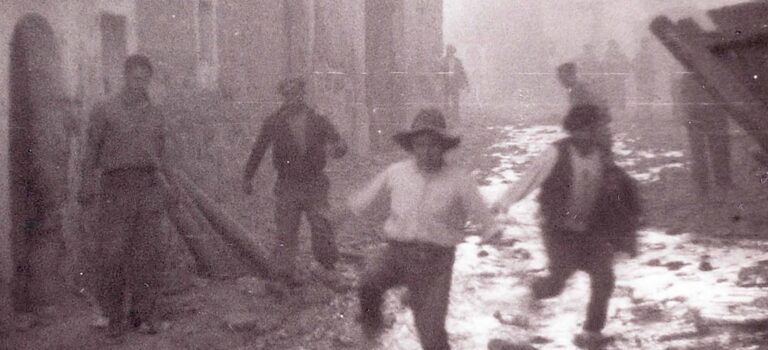
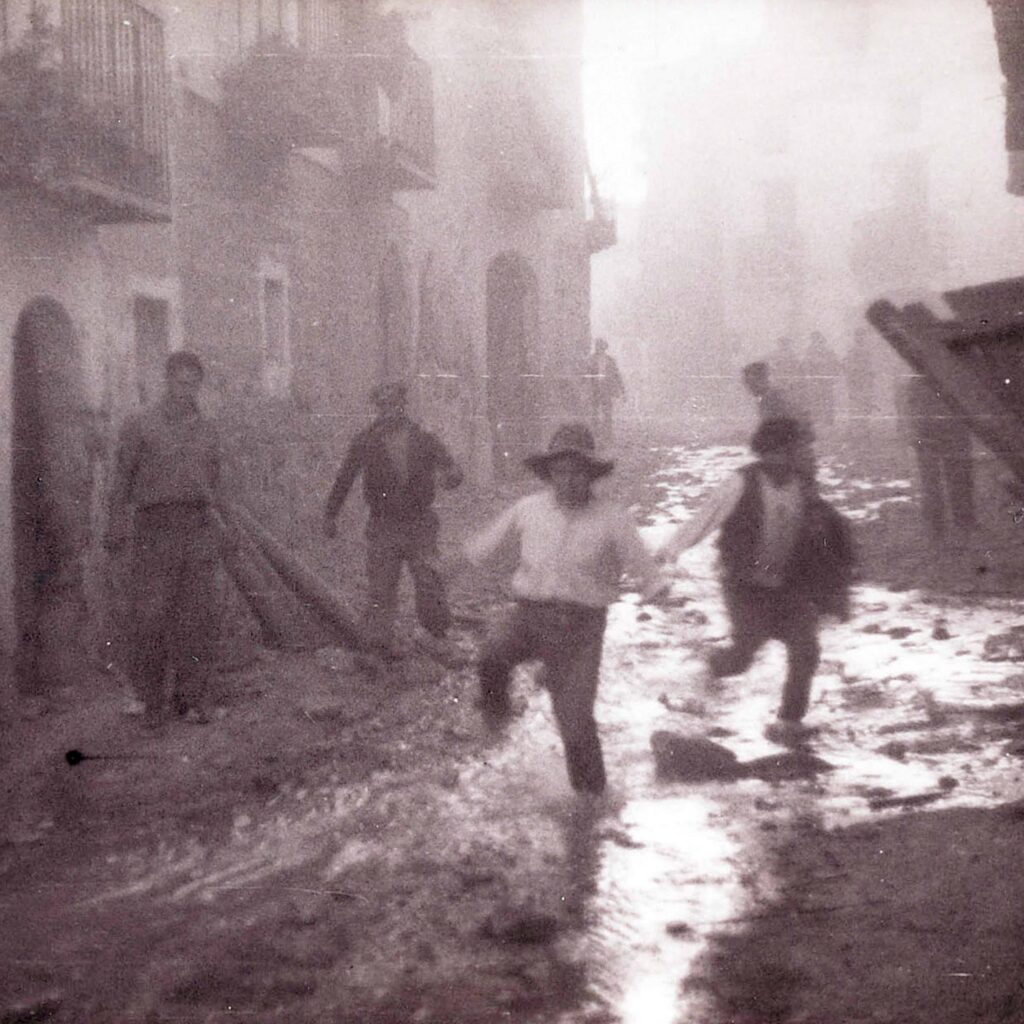
Civilians flee nationalist army shelling on Madrid, during the Spanish Civil War 1938. Source: Alamy
Q.What are you currently working on? Is there anything you can share with us?
Absolutely! I’m hard at work on the follow-up to We Are Made.It’s set in 1942 and features some of the characters from the first novel. I’m planning to publish it in summer 2026.
Q. What’s one piece of advice you’d give to new authors?
It’s not very original but my advice is to keep plugging away! Writing a novel is a marathon, not a sprint. You have to accept that some days will be about hard graft rather than soaring artistic vision. If you get really stuck, have a little rest and return to your manuscript with fresh eyes.
After I’d laid down my first eighty thousand words, it became evident that I had something to offer which could perhaps be done as a shorter ‘non-biography’. More like an anthology of short stories.
I’d heard about writers who had ‘self-published’ so… “Why not me?”
I knew enough about white space, thought I was good at layout, had an inkling about marketing. “Why couldn’t I do it myself?” And so, even if a little deluded, I did. I had loads to learn – could and did find much in myself to criticise, certainly found I had huge dollops of pride to swallow and large amounts of patience to spread on myself – but in 2024 I did it. Although it had been one hell of a learning curve.
It was in January, I sat with my reduced 52,000 words and had my first meeting with Black Swan Printers. He almost believed I knew what I was talking about – in the end going along with my visions of grandeur and agreeing to work with me.
First time meeting Black Swan Printers – trying to look a bit like a writer.
Taking his good advice, I amended, edited, corrected, re-wrote and re-numbered until I had 200 pages. This final draft was then proof-read by a suitably experienced friend who drew my attention to the overuse of “OK” and “of course” and “in fact”.
She also directed my attention to an inconsistent use of capitals across most of my forty chapter headings and told me to also give serious attention to NOT starting so many sentences with “And”. Later in the list of suggested alterations, I was scolded for… and I quote: “Excessive use of the word ‘ahead’… used at least eight times”!! And when talking about going off the road during a driving accident – she suggested I was more probably zig-zagging on a central reservation – and not “on a central reservoir” as I had written. There’s nothing like a professional critic to firmly put you in your place!
Sebastian often disapproves of my writing!
I didn’t even know what ‘tautology’ meant, until I saw my own words saying the same thing twice in a different way. It came as quite a shock to discover I’d claimed to live through ninety decades…. 900 years!
And as an English graduate, I was suitably humbled to find that I obviously couldn’t spell, couldn’t tell the difference between ‘chose’ and ‘choose’ – and had incorrectly used “were” instead of “was”!
Yes, the proof-reader who had originally told me there were “a few minor tweaks”, presented me with twenty-seven pages of notes, drawing my attention to so many of my errors… but it was the best lesson for putting my feet firmly back on the ground. To hell with the euphoria of finishing a book. The business end of it all now had to be cleaned up. This is what professional writing is all about – getting it right.
Although, with some slight relief, I was gently reassured that there wasn’t a single book out there which could claim to be completely perfect!
So on that note, I poured a large glass of Chateau-Neuf, before starting out on what was to be five days of corrections. It seems there was always something (even as slight as a missing apostrophe) that needed attention on almost every one of my two-hundred pages. A page at a time, I looked at every sentence and noted all that had been ‘proofed’ and made my decisions about what to keep and what to change.
Dark and dangerous, from my chapter ‘Fugitive on the Isles of Scilly’
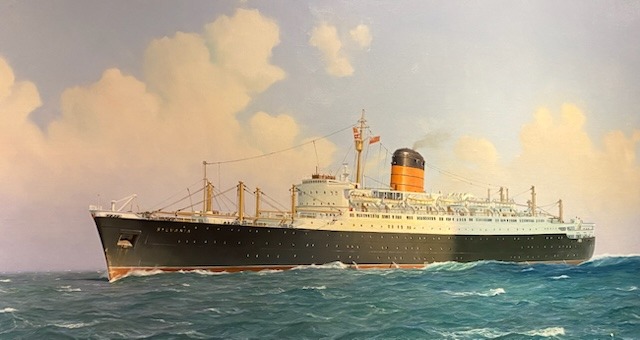
My 1957 passage to Canada via early Cunard… memory working hard writing that section.
But by now, it was all much too late to re-write without upsetting the page numbers and paragraph layout of the whole book, I had to let some things go.
“Minor tweaks” indeed… the devil is certainly in the detail!
If you are self-publishing, this post might be of limited interest to you. Agents and publishers, though, are actively looking for inclusive writing.
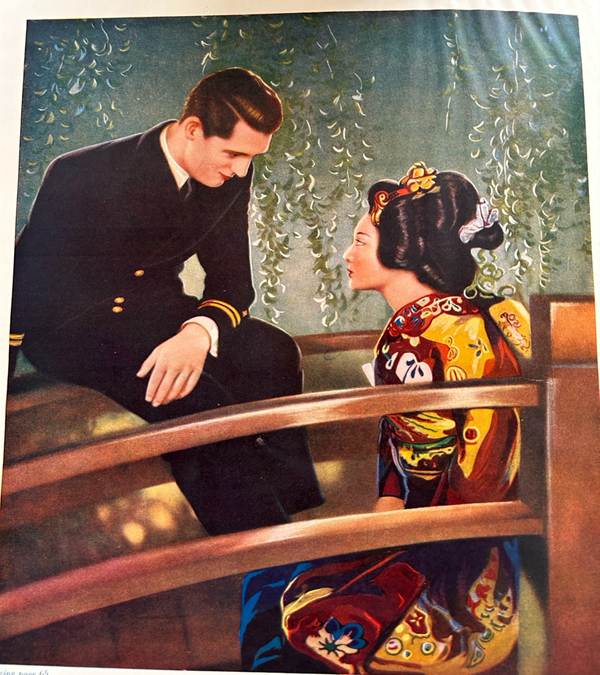
The play and film, “Madame Butterfly” might be an example of how Asian women were often depicted. An American naval officer serving in Japan at the beginning of the 20th century, has a son with a 15 year old girl, Cio-Cio-San. The officer then leaves her, and goes back to America to marry someone else. Abandoned and shamed, Cio-Cio-San takes her own life. A tale of sexism, racism and stereotypes.
The few Slavic men who don’t get cast as villains are usually based on humiliating stereotypes. They’re the eccentric sidekicks who chug vodka with every meal, play the accordion and keep bears as pets.’ and, ‘Western media discards the socioeconomic explanations and portrays most Slavic women as promiscuous gold-diggers, like Irina Korsakov from “Desperate Housewives” or Svetlana Yevgenivna from “Shameless.”
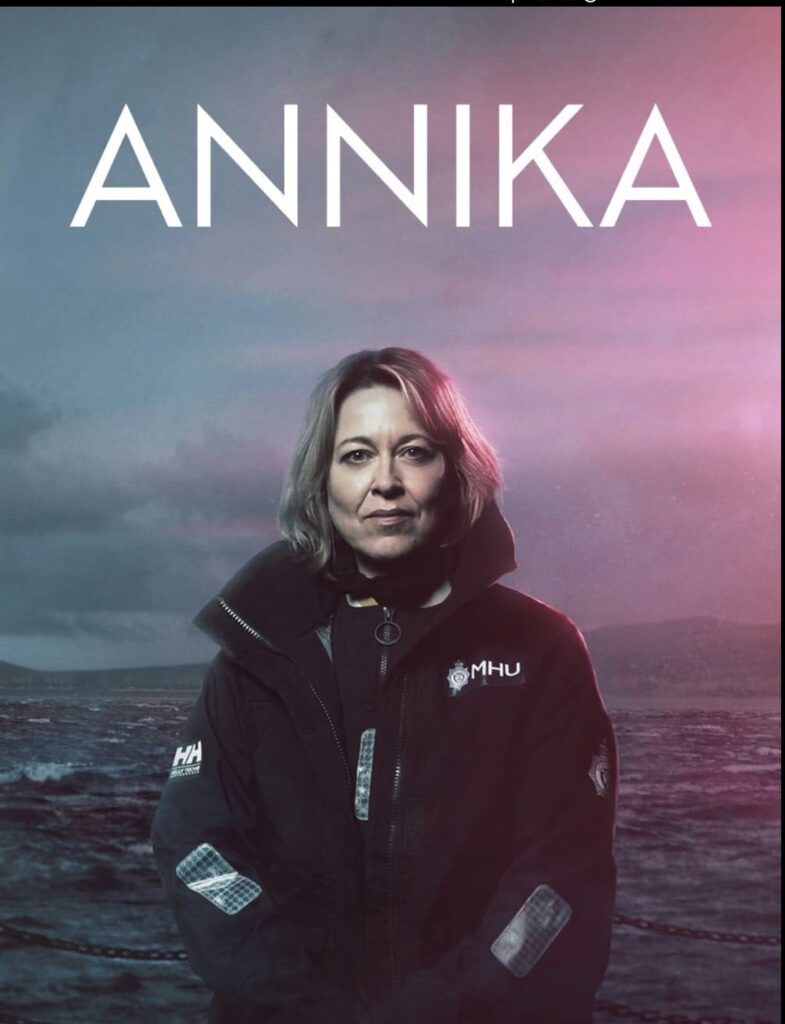
Even in what appears to be an inclusive detective series, “Annika” (series 2), the scriptwriters still use this stereotype in a hotel scene with the Central or Eastern European receptionist.
Wokeness isn’t a new phenomenon, writing with a social conscious has often brought about changes in the world.
These rough rules are continually changing, so the only sure help for the inclusive writer is to do plenty of research and keep up to date. The ongoing discourse about J K Rowling’s books is a good place to find a range of opinions.
Perhaps considering that a person can still be executed in eleven countries for their sexual orientation shows how much support and change is needed in this world, and good Woke writing can open our readers’ eyes to diversity.
We are human, and we are going to have views and opinions that we might find problematic for publishers, so being aware of some of the things that agents and publishers usually won’t accept, can only help if we want to be traditionally published.
Rough dos and don’ts:
Ableism:
Using a disabled character who suddenly becomes able might well be rejected, especially in children’s books, because it can cause the child to feel less worthy. They want to relate to a character like themselves, who succeeds just as they are,.
Neurodiversity:
Is the same for Neurodiverse characters (the name, Neurodiverse, is my pet hate because all our brains are normal – they don’t have to function in one specific way). We didn’t test for ADHD in boys until the 1950s. Girls weren’t tested until the early 90s.
The list is added to all the time as we discover new variants – new to us maybe, but they have always been there.
A list you might find useful:
HSP: Highly Sensitive Person (the only diversity that is, at the present time, known to be heretical). Often portrayed as being over emotional, dramatic, thin-skinned, over reactive. Often confused with ADHD which it can also co-present with.
Autism: Writing characters who we believe are stereotypical of Autistics – good with numbers, communitive, lacking in empathises is a narrow, old-fashioned view and often, incorrect.
ADHD: A stereotypical point of view might be a young boy causing mayhem in the class with his hyperactivity. For women it’s being forgetful and muddled.
Co-Presenting: People can present as have a wide range of neurodiversity. I am ADHD with Dyslexia. A very common one is ADHD/Autism known as AuDHD.
Dyslexia: The NHS describe dyslexia as, ‘a common learning difficulty that mainly causes problems with reading, writing and spelling. Unlike a learning disability, intelligence isn’t affected.’
Bipolar: It is not a neurodiversity but it can exist alongside one, as can anxiety and depression.
All the above conditions may be assumed but they can only be clinically diagnosed by a physiatrist. You can’t be a bit ADHD. You may have traits with which one can seek a diagnosis, but the rigour testing is the only sure way to know. This is especially important because neurodiversity may mimic or be a cause or symptom of depression, anxiety, and trauma.
Beware of:
Sexism: It is still around, although thanks to the Me-Too movement, it is much more likely to be called out. The Peter and Jane books of my childhood seemed innocent, but would never get published now.
Consent: I got reprimanded by an agent because my protagonist made a pass at a guy and told him she wanted to sleep with him. I’d also had her getting quite drunk first to give her courage. The problem, the agent said, was with ‘Consent.’
Being drunk, the girl wouldn’t have been able to make an informed decision and technically not consent to sex. Using assumed consent from an inebriated person wouldn’t stand up in court and could be considered, rape. Remember the furore in Poldark when Ross Poldark seduced or forced himself (depending on your view) Elizabeth Chynoweth?
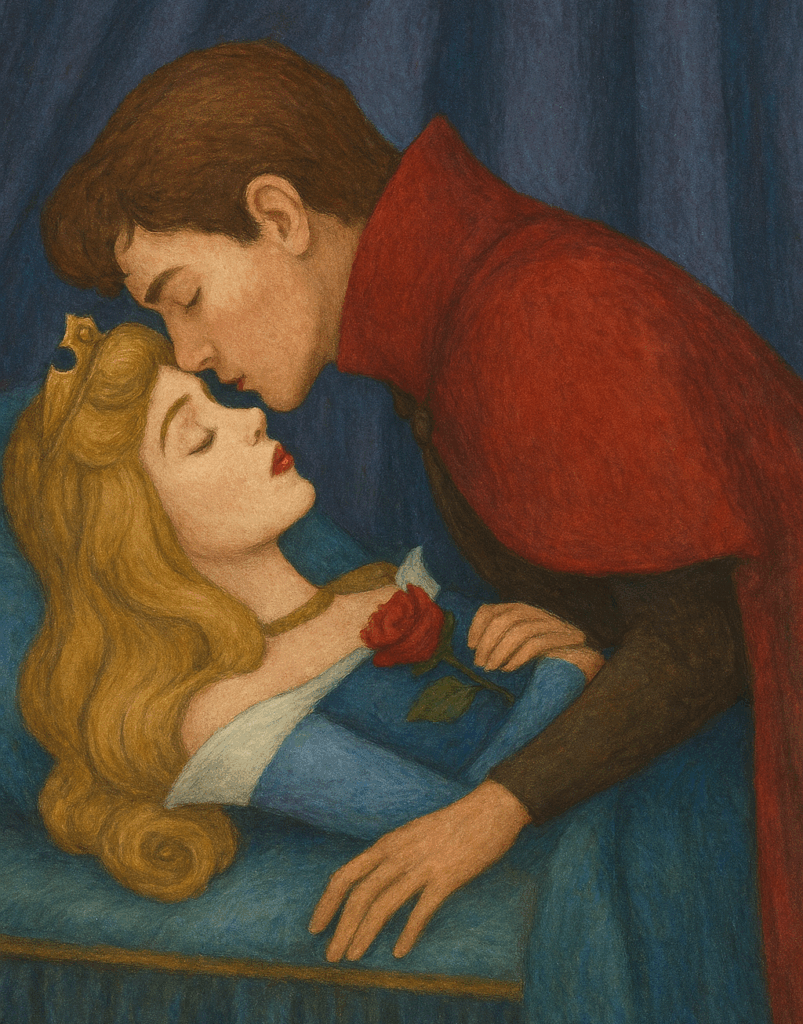
Sleeping Beauty
Sleeping Beauty, came under attack because she was asleep and so couldn’t give consent to being kissed.
A while ago now, a friend of mine said this was all ‘PC’ – ‘political correctness,’ a term that is rarely used now.
Transphobia: It is perhaps easer for some to write a transphobic character than it is to know and write about all the wonderful ways people identify with. This is a short list which will be quickly outdated, so keep your finger on the pulse:
Agender: A person who does not identify with any particular gender
Bigender: Someone who identifies genders
Cisgender (Cis): One who identifies with the sex they were born with.
Demigender: partly identifying with a gender, i.e. a demigirl.
Genderfluid: A person who’s gender identity isn’t fixed
Intersex: Having sex characteristics that cannot be defined as expected notions of female or male.
There are many more terms and ‘labels,’ for sexual identity. Many people these days feel that whatever you feel you are – you are, and should be treated and respected as such. And, of course, lots of people don’t share that view and are vocal about it. It is a free country but I believe it is unhelpful not to recognise anyone’s right to define themselves as they identify.
J.K. Rowling is so successful that she holds a powerful position of authority in speaking for those who take issue with diversity and has been accused of promoting stereotypes and transphobia. Of course, she is not alone but she is still actively promoting her views which who read her books in childhood now feel upset by.
As an aside, the Bechdel test, started as a joke is an interesting way to see how much agency female characters have in films. In short, to pass the test a movie must have at least two named characters having a conversation together where a man doesn’t feature.
Ways that help an agent/publisher Reject your M/S:
Having a gay, black, or disabled character as your villain. I know in real life they could easily be, but ethnic minorities have suffered for centuries and writers can encourage inclusivity by their actions.
It is notably that in the past, white Americans, black Americans, Chinese Americans, Latino Americans etc. all had boxes to tick on forms to show their nationality. Even a few years ago this was not the case for Native Americans.
If you do have a racist or otherwise prejudiced character, they shouldn’t win the day. They can change their views, but a prejudiced person whose views in dialogue, action, etc. cause pain and distress to others doesn’t make a character most readers would root for, or want to go unpunished.
Appropriation of other cultures/races:
The book, The Help, by Kathryn Stockett, drew negative criticism for depicting a white woman telling the story of a generation of black maids in the 1960s southern states of America, especially the character, Aibileen.
Some viewers of the film described the protagonist as a white saviour. Sooner or later, someone of colour would have written the story of the black maids. So, the consensus seems to be that it wasn’t Stockett’s story to tell.
Ageism (The last, seemingly acceptable, prejudice?)
In novel writing, Ageism can manifest as stereotypical and negative portrayals of older characters, reflecting broader societal biases about ageing. This can range from physical descriptions emphasising decline and frailty to characterisations that reduce older individuals to eccentricities or comedic figures. Furthermore, ageism can affect publishing decisions, with some agents and editors potentially exhibiting bias against older writers, though this is not universally accepted.
Here’s a more detailed look at the issues of
Stereotypical Representations:
Physical Decline: Older characters are often depicted with physical limitations like poor hearing, failing health, or frailty, reinforcing negative stereotypes about ageing.
Cognitive Decline: Ageism can lead to portrayals of older characters as forgetful, confused, or lacking in mental acuity, which is not always accurate.
Emotional States: Older characters are sometimes portrayed as lonely, bitter, or reliant on younger characters, perpetuating harmful stereotypes about emotional well-being in later life.
Humorous Reduction: While some positive portrayals exist, they can still fall into the trap of reducing older characters to humorous stereotypes or eccentric figures, rather than complex individuals.
Impact of Ageist Depictions:
Reinforcing Negative Stereotypes: Stereotypical portrayals in literature can reinforce negative perceptions of ageing in society, leading individuals to internalise these biases.
Self-Perception: Ageism can affect older individuals’ self-esteem and self-perception, making them more likely to believe the negative stereotypes they encounter.
Loss of Autonomy: Ageist narratives can contribute to a sense that older people are less capable and less independent, impacting their agency and social participation.
Challenging Assumptions: Writers can actively challenge ageist assumptions by creating complex and nuanced portrayals of older characters, highlighting their strengths and contributions.
Focus on Character, Not Age. Ultimately, the focus should be on creating compelling characters, regardless of their age, rather than reducing them to age-related stereotypes.
Stereotyping by Appearance
Having larger people classified as greedy, lazy or lacking willpower or the generalisations of smaller people or those with disfigurements.
Personally I like novels where a person’s appearance isn’t described apart perhaps, in the internal dialogue of a character. Shows such as Bridgeton gained huge audiences.
Try to Avoid Stereotypes such as These:
Barely verbal autistic man (i.e. Hoffman’s character in Rain Man).
Tiny, submissive Asian women (Harry Potter and Madame Butterfly) sexist, racist and classist, in many peoples’ opinion.
Using worn-out and hurtful physical descriptions to trigger antisemitism, as in Jews having large noses and being mean (from Shakespeare’s Shylock to the Goblins running the banks in the Harry Potter series).
Irish people experimenting with explosions (terrorists) – such as the Irish kidnapper and former British soldier in Netflix’s The Hostage.
Tall, gentle, magical black guy whose father left the family (often the token)
I hope some of the above is of use. It has taken me longer than expected (ADHD brain fog) to write this little blog post. Except one section where I used A.I., that particular part took me 5 minutes to copy and paste. But is it art?!
I recommend Lucy V. Hay’s book, Writing Diverse Characters for Fiction, TV or Film as it digs down in detail her views and advice about diversity in writing. I find it really helpful although I disagree with some points here and there.
While writing this post, I wanted to research what is probably the most appropriated people ever – the Native Americans. I wanted to find books written by them and typed in Google, ‘pure native American authors.’ Google immediately told me that my use of, ‘pure’ was problematic. I’m still learning…
The world is feeling particularly wild at this moment – global politics, climate change, conflicts across continents. It sometimes feels we are on a tipping point, about to fall into an abyss. A friend recently said to me he thinks humans are either going to wipe each other out, or transcend into a new consciousness in our lifetime – he’s a psychotherapist. I’m often left wondering if there’s some truth in his comment. People are stressed, frightened and overwhelmed. Humankind is in need of a healing balm. So, where do we turn?
We turn to stories. Short stories, novels, graphic novels, films. Stories at their core are a place we go to make sense of the world. When we cannot make sense of things, we use stories to help guide us. Narratives, characters, plot – they offer us another way of experiencing life and the world around us. Throughout history, writers and artists have created from their life experience and shared their wisdom with others.
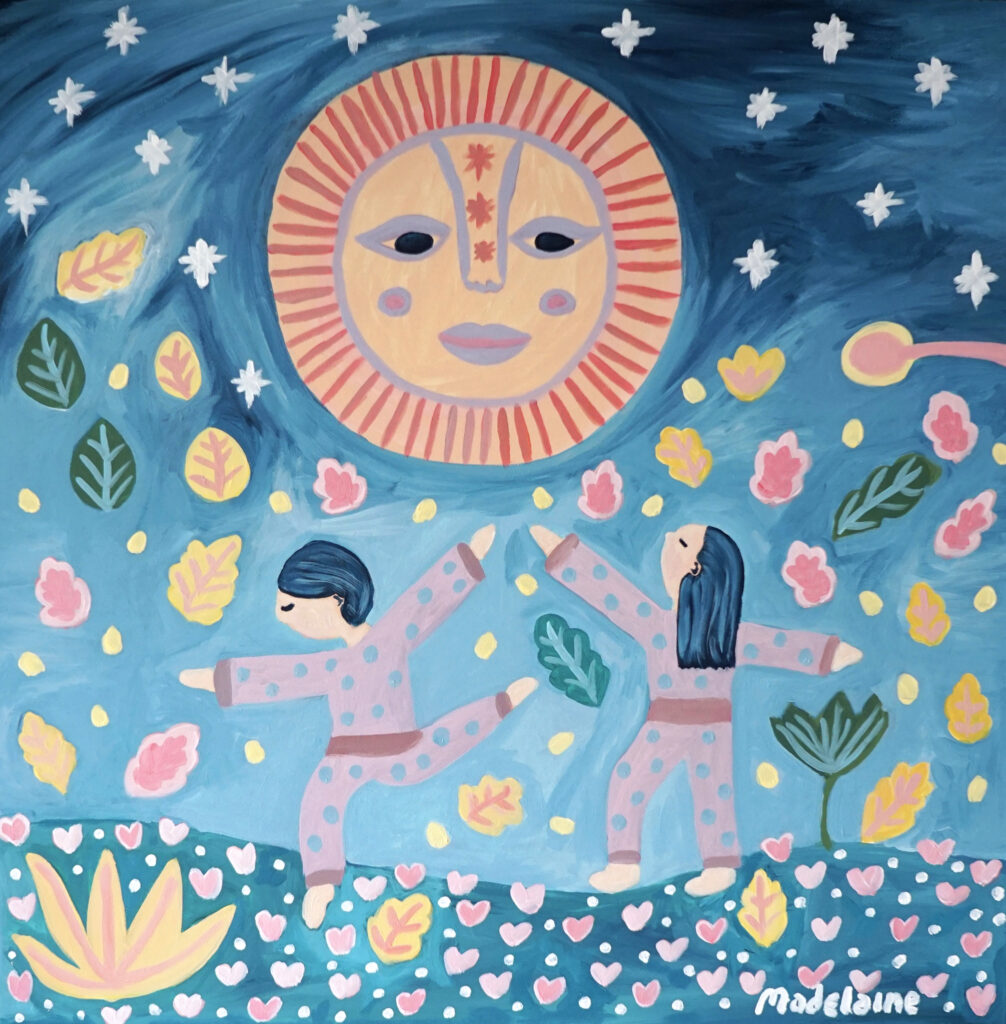
‘Moon Dancers’ by Madelaine Couch
I started taking my creative writing seriously about ten years ago – pitching to publishers and literary agents in the hope of getting published. I began pitching a picture book manuscript, which got rejected. Then I wrote a memoir, which over the course of a few years got rejected. Next came a YA novel, which so far has also not found a home. I was naive at first, thinking I could just write and get published within a few years. I had no idea about the reality of the writing path that lay ahead. I developed a love of the short story and short story writers – Haruki Murakami, Alice Munro, Raymond Carver – and began to hone my craft. Through relentless reading, listening to hundreds of hours of interviews, and writing my own stories and essays, things started to look up. I began to see my work published – in newspapers, online, and longlisted in writing competitions. It felt good, hopeful. Like all this effort wasn’t wasted. I now know, it’s never wasted.
But something else happened in the last decade. I became less obsessed with focusing on publication and more fascinated by what writing stories is actually all about. Throughout history, people have always told stories. Our ancestors sat around the fire telling stories to one another. People read fairy-tales to children, and I read countless books to my little girl now. Why do we do this? I’ve come to see the power of storytelling as a balm for the heart. It’s a place to find solace in our suffering. When the world went into lockdown, the arts were a place of healing for many. People read, they watched films, and listened to radio plays. Stories were a space for us to feel less alone – to make sense of our pain.
(‘Woman Thinking’ by Madelaine Couch)
The Italian writer, Gianni Rodari, emphasised the importance of the human imagination. He explored the possibility of positive change in the world through storytelling. The fact that a story can help us to empathise with other human beings, guide us through hardship, or create hope in a world that is challenging, quite literally changes us. If a story is written well, we gain so much from it. We are gifted knowledge on how to navigate life – whether that’s emotionally, spiritually, mentally. We learn about human relationships, and how to handle them better. We may go on a personal journey of self-discovery, overcoming our fears and moving on from our setbacks.
I’m pretty sure books have saved me more than once in my lifetime. And they will continue to do so. Writing is an act of love – to our readers. It is taking the time to go inwards, excavate our life experience, and blend that with our imagination to craft something meaningful and magical. In a world that is full of chaos and suffering, storytelling is an act of courage. Writing is an act of hope – and one that I will continue to do until I cannot hold a pen anymore.
***
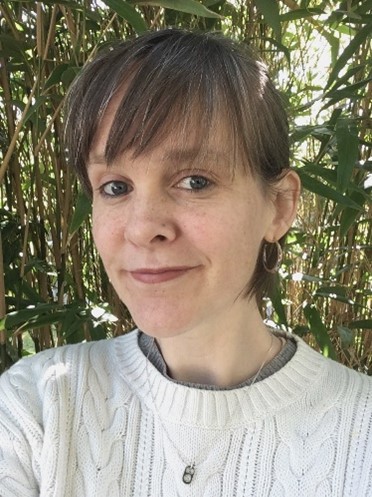
Thank you for reading. I’m a writer and artist currently living in South Devon.
This will be my seventh book, and I have high hopes as seven is considered to be a lucky number – according to PlanetNumerology.com. Google also tells me that seven also features prominently in both popular folklore and various religions, so there’s that too. It has personal significance for me, as it is the number of times I usually have to be told something before I take any notice of it.
The book is a combination of two stories that I had been mulling over, one about a young homeless person and the other about a woman with PTSD.
With nowhere to live and no job, Joe needed something to read, to fill some empty hours. The drawings in the margins of the charity shop book were intriguing and beautiful, swirling across the page and hinting at unseen figures and places. He knew he had to find out who had drawn them, but how could he start on a quest like that?
If Angela’s house is like a prison, it’s only because she has made it that way after the accident. Now she wants to break out, but she doesn’t think she can do it alone.
They are both helped by strangers who become friends, and their paths cross in the most unexpected circumstances.
At first, there didn’t seem to be any obvious connection between the two of them, and they were destined for hard drive limbo. But once I had added in some mysterious and beautiful found artwork, they came together quite easily. Well, as easily as any book does when you are trying to work out who is doing what, when and why, while attempting to make the characters do the heavy lifting of the storytelling.
My previous books have mostly been introduced to the world in a low-key way. I press the ‘publish’ button on Amazon, then send out a Facebook message to people who know me and hope. Despite this laissez-faire attitude, and helped by some low-key advertising, my books do seem to manage to get noticed eventually. But this time I have decided, in my wisdom, to have a book launch.
I should say straight away that I have never been to a book launch before and have no real idea what is supposed to happen. I’m guessing people will queue up to shake my hand and speak to me before buying the book, insisting I write a personal message in it for them before having their photo taken with me.
Whatever, celebrating the birth of a new book seems like a fun way to spend an hour, so I’m going for it.
If it’s just me, standing next to a pile of books in an empty shop, then that’s what it is. If it’s a case of a few people dropping in and chatting with me, so much the better. The best part of it is that it will be in my local record store, so if nobody turns up, I can at least spend the time browsing the vinyl.
If you want to join me, you will be able to buy my books CHEAPER than you can online. I will be at Teignmouth’s SPS Records (The Folk Preservation Society) from 6 to 7pm on Wednesday, 30th June.
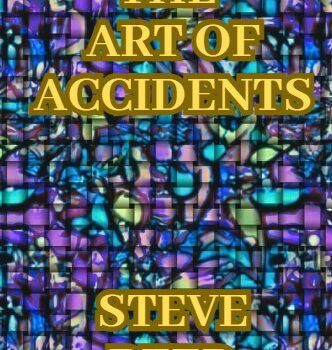
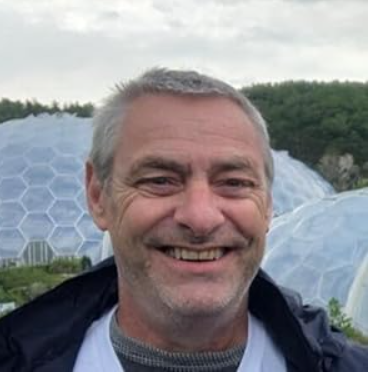
Find out more about the author, Steve Beed, and buy his books here
For the first time in years, I’m not writing. Instead, I’m counting down the days until my new children’s book – The Invisibles – flies into the world.
On my desk, like a reproach, sits a quote by Elizabeth Gilbert from Big Magic, her brilliant book on creativity:
If your calling is to make things, then you will have to make things in order to live out your highest creative potential – and also in order to remain sane. Possessing a creative mind, after all, is something like having a border collie for a pet: It needs to work, or else it will cause you an outrageous amount of trouble. Give your mind a job to do, or else it will find a job to do, and you might not like the job it invents.
Without daily writing, time echoes emptily. Dust balls roll… tumbleweeds tumble… and metaphors mix. My inner border collie has been chasing its own tail for months. Recently, it began to turn its attention to much more troublesome activities, such as overdosing on chips and looking for drama. So since there appears to be a vacancy in my head for the job of Writer, I’ve decided to pretend I’m a Publicity Person instead: one of the numerous jobs a Careers Advisor would advise me not to do, since I’m a dedicated introvert and technophobe. Of course, my publisher (Pushkin Press) will be marketing too: but they have lots of books to market and limited time.
So far, I’ve had 500 postcards printed, have signed 400 of them and added sparkly stickers to each and am now in the process of ringing as many of the 300 branches of Waterstones as I can, together with about 75 independent bookstores, offering signed postcards to any who are thinking of stocking my book.
I’m also learning stuff about social media, posting on two Facebook pages, Bluesky, Instagram and the dreaded X (or TWIX as I prefer to call it).
I’ve even commissioned this animation, made by the amazing John Duffty at Irontree Media whose generosity, creativity and commitment astound me (put the sound up, he does music and sound effects too!):
Will any of this make a difference? Well, Waterstones have been kind – several have offered to increase their orders (each branch often only orders a single copy) and a couple of stores have even offered to put my book on their tables (the publisher usually has to pay for this privilege). A book blogger saw my posts on social media and reviewed The Invisibles favourably, which made me very happy.
And all this activity helps fend off the cloud of helpless anxiety that whispers between my ears as publication day approaches. Will anyone buy my book? And if they do… what will they say about it?
The irony is that publication day is always an anti-climax. Publishing a book reminds me of that famous painting of Icarus by Pieter Bruegel the Elder: far away and very small, the body of a boy falls out of the sky and plummets into the ocean with a distant splash. Meanwhile, the world goes about its business: a fisherman casts his net, a ploughman ploughs his furrow; a shepherd (along with his medieval border collie) stares mindlessly into the distance. And another book imperceptibly joins the millions available… Wish me luck?
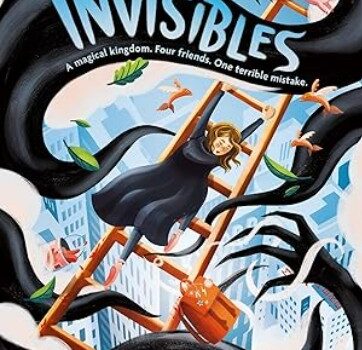
A magical kingdom. Four friends. One terrible mistake…
In the Land of Magics, four friends live a life filled with wonder. But there’s one rule they must not break: never set foot on the Island of Darkness. So, when one child does the unthinkable, they must all pay a terrible price – exile to Wasteland, the bleak world where only grown-ups live. For Grace, this fate is particularly cruel. She wakes up with no memory of her magical home, or how she ended up here – and the only clue to her past is guarded by two hostile and mysteriously invisible children. As Grace uncovers the Invisibles’ secrets, she must work out a way to return home, before Wasteland traps her forever…
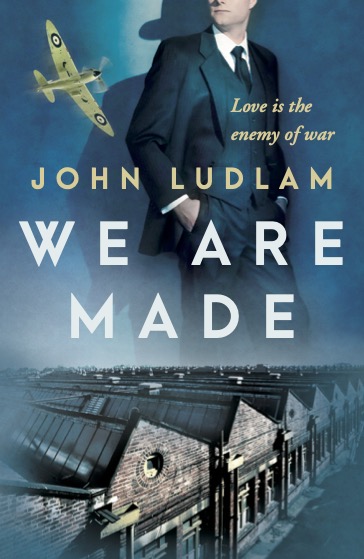
Local author, John Ludlam, has released a gripping new historical novel set in the dark days of 1938, as Europe was sliding towards the chaos of all-out war and Britain faced an enemy it didn’t yet understand.
Set in London and war-ravaged southern Spain, We Are Madeis a deeply affecting exploration of love, loss, and moral complexity played out against the brooding backdrop of pre-war London.
William, torn from academia by grief and responsibility, finds himself drawn into the industrial pulse of Spitfire production and the shadows of espionage. As he reconnects with Elizabeth, their love story is woven into an intricate web of political and personal tensions.
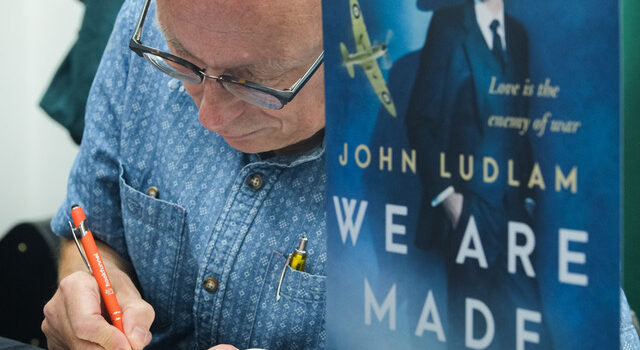
Local literature fans gathered at TAAG (Teignmouth Arts and Action Group) for a lively book launch, where John gave a reading and signed copies of the novel.
For more than thirty years John covered international news for the Visnews and Reuters news agencies.
We Are Madeis the first in a series of novels examining what geopolitics does to people.
‘My years as a video agency journalist have taught me that geopolitics will never leave us alone,’ he said. ‘Ordinary people are always caught up in the ambitions of those who shout the loudest. This is as true today as it was in 1938, when We Are Made is set. Men, shouting… That pretty much sums up geopolitics.’